
Behind every busy commercial kitchen is a floor that takes more punishment than most people ever see. Fryer grease, rinse water, rolling racks, dropped cookware, cleaning solutions, heavy equipment, and a steady stream of employees all put the surface to work.
For Georgia restaurants and food-service facilities, that daily wear is often paired with a hot, humid climate and kitchens that rarely have much time to slow down. A floor that looks fine in a light commercial space may not last long under those conditions.
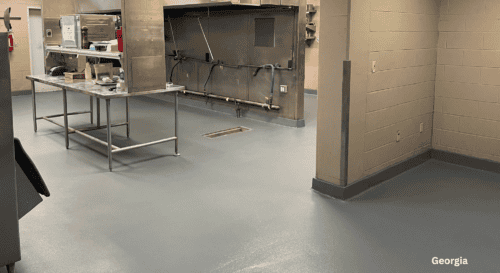
Industrial Applications, Inc. installs commercial kitchen epoxy flooring in Georgia for facilities that need more than a basic coating. Flooring options include epoxy systems, urethane cement, MMA flooring, antimicrobial coatings, coved bases, and other seamless resinous systems suited to food-service and food-production environments.
Our commercial flooring systems are used in restaurants, schools, universities, country clubs, hotels, institutional kitchens, healthcare facilities, cafeterias, food-processing areas, and other Georgia facilities where cleanliness and durability are part of everyday operations.
Selecting the right floor starts with understanding what happens in the kitchen. Industrial Applications reviews the condition of the concrete, where moisture tends to collect, how the floor is cleaned, the amount of heat it sees, traffic patterns, drainage, safety concerns, and how long the facility can reasonably be out of service.
A kitchen floor should do more than improve the appearance of the space. It should make daily maintenance easier, stand up to demanding use, provide the right amount of traction, and support the operation without becoming another maintenance problem.
📞 Planning a kitchen renovation or dealing with a failing floor?
Call Industrial Applications Today
at 901-794-4334 or complete the contact form to speak with an experienced commercial flooring professional.
Contact Us For a Free In-Depth Flooring Evaluation
Concrete has a reputation for being tough, but strength and resistance are not the same thing.
An untreated concrete slab can absorb grease, water, food liquids, cleaners, and other materials that regularly hit a kitchen floor. Once those materials begin working into the surface, the concrete may become stained, rough, cracked, pitted, or harder to sanitize.
Commercial kitchens put that surface through the same cycle again and again: prep, service, cleanup, washdown, and then back to work.
A properly designed commercial kitchen flooring system adds a protective layer between those daily conditions and the concrete underneath. Epoxy and other resinous flooring systems can create a smoother, more continuous surface that is easier to maintain than bare concrete.
Water does not stay neatly around the sink in a working kitchen.
It may come from dishwashing stations, ice machines, refrigerators, food-prep areas, drains, mopping, equipment cleaning, or everyday spills.
In Georgia, warm and humid weather can make moisture management an even bigger consideration, especially in facilities where conditioned indoor spaces are constantly exposed to humid outdoor air.
The temperature at floor level can change quickly in a commercial kitchen.
Hot water may hit a cooler floor. Grease can splash from fryers. Steam may escape from equipment. Areas near grills, ovens, kettles, and cooking lines may stay considerably warmer than surrounding spaces.
Those temperature swings matter.
Industrial Applications evaluates those conditions before deciding whether epoxy, urethane cement, or another system makes the most sense.
What lands on a commercial kitchen floor can be surprisingly aggressive.
That combination can be hard on both bare concrete and coatings that were not designed for chemical exposure.
Industrial Applications considers the products used in the kitchen and recommends flooring based on the type of chemical resistance the facility is likely to need.
That is particularly important in operations where aggressive cleaning and sanitation procedures happen every day.
A perfectly smooth floor might be easy to wipe down, but it may not provide enough traction in a kitchen where water and grease are common.
The best slip-resistant commercial kitchen flooring usually falls somewhere in between.
Industrial Applications can adjust flooring texture based on how each area is used.
Employees are only part of the traffic crossing a commercial kitchen floor.
Then there is impact.
Pots fall. Containers are dropped. Equipment gets moved. Heavy items land exactly where you wish they would not.
Those stresses can wear through thin coatings and make existing concrete damage worse.
A properly specified commercial kitchen epoxy flooring system or urethane cement system gives heavily used areas a more substantial layer of protection against abrasion and everyday impact.
Commercial kitchen flooring is often called “epoxy flooring,” but epoxy is not the only resinous system available. In many kitchens, the best solution may include epoxy in some areas and urethane cement in others.
Industrial Applications selects the floor based on the conditions in each kitchen zone rather than applying one product throughout the building.
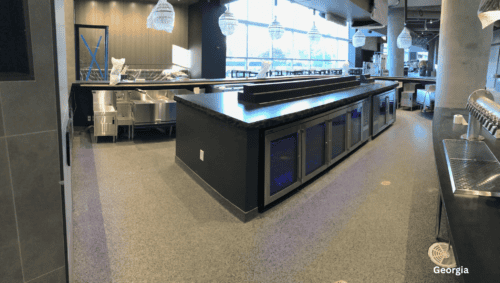 Industrial epoxy flooring can be a strong choice for areas that need a seamless, durable, cleanable surface but are not exposed to extreme thermal shock.
Depending on the system selected, epoxy may work well in:
Urethane cement, sometimes called cementitious urethane or urethane concrete, is frequently recommended for the most demanding kitchen zones.
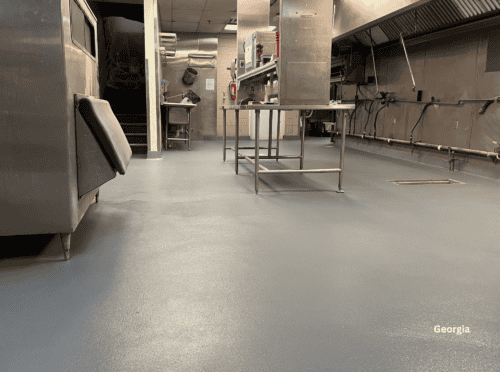
These may include:
Urethane cement is commonly selected for its resistance to thermal shock, moisture, chemicals, impact, and heavy traffic. Industrial Applications selected a cementitious urethane system for the Frida’s Restaurante Mexicano project because the kitchen required chemical resistance, thermal resistance, slip resistance, durability, and manageable maintenance.
The most expensive system is not automatically the best system for every square foot. A zone-based flooring plan can place higher-performance urethane cement in wet and hot areas while using epoxy or another appropriate resinous system in surrounding spaces.
This approach can help control project costs without under-specifying critical kitchen areas.
No flooring system by itself makes a commercial kitchen or food-processing facility compliant. Compliance depends on the complete operation, including food handling, sanitation procedures, drainage, equipment, employee practices, pest control, maintenance, and the physical condition of the building.
The floor should support those requirements rather than make sanitation more difficult.
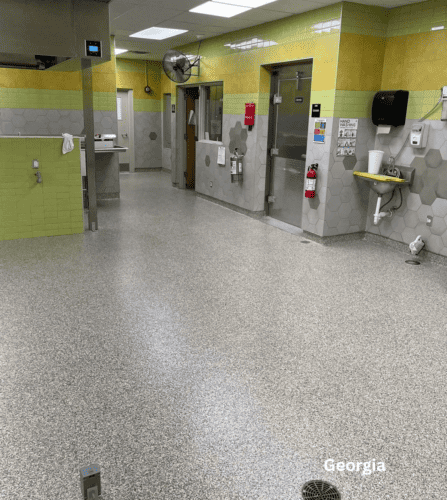
The FDA Food Code states that indoor floor surfaces in food establishments should be smooth, durable, and easily cleanable. Areas subject to moisture should also use nonabsorbent materials. The Food Code further addresses coved floor-to-wall transitions and requires floors used with water-flush cleaning methods to be graded to drain with coved and sealed junctures.
Tennessee food-service rules contain similar requirements for smooth, durable, easily cleanable surfaces; nonabsorbent materials in moisture-prone areas; and coved or sealed floor-to-wall transitions.
For USDA-regulated operations, federal sanitation standards state that floors must be constructed from durable materials that are impervious to moisture and capable of being cleaned and sanitized as necessary. Adequate drainage is also required in areas exposed to flooding-type cleaning or routine liquid discharge.
FSMA takes a prevention-focused approach to food safety. Covered food facilities may be required to maintain a written food-safety plan that includes hazard analysis and risk-based preventive controls. A cleanable, well-maintained flooring system can support that broader sanitation program, but the floor is only one part of facility-wide compliance.
Industrial Applications can help facility owners, architects, general contractors, and food-service operators select a flooring system that supports:
Final approval and compliance remain subject to the applicable regulatory authority, inspector, project specifications, and facility operation.
The field of the floor is only part of a sanitary flooring system. Floor-to-wall transitions, drains, equipment pads, columns, penetrations, joints, and door thresholds can become weak points when they are not properly detailed.
Tile floors contain grout lines. Sheet flooring contains seams. Standard wall bases may leave joints where water, grease, and debris can collect.
A poured resinous flooring system creates a more continuous surface with fewer places for residue to become trapped. Seamless construction also makes routine cleaning more predictable.
An integral coved base extends the flooring material vertically at the wall, creating a rounded transition instead of a sharp ninety-degree corner.
Coved bases can:
The height, radius, termination, and material of the cove should be selected for the facility and coordinated with wall finishes, equipment, drains, and cleaning procedures.
When specified, antimicrobial additives may be incorporated into certain resinous floor-coating systems to help inhibit the growth of microorganisms on the protected coating surface. Industrial Applications offers antimicrobial floor-coating options for commercial kitchens and other sanitation-sensitive environments.
Antimicrobial flooring does not replace proper cleaning, sanitizing, drainage, or maintenance. It should be treated as an additional feature within a complete sanitation program.
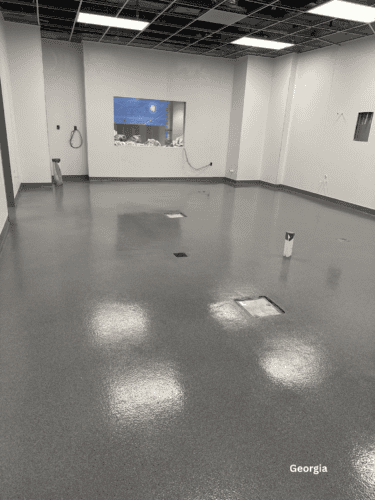
Closing a kitchen for an extended flooring installation can affect revenue, food production, staffing, events, deliveries, and customer service. Industrial Applications plans commercial kitchen flooring projects around the facility’s available downtime whenever project conditions allow.
Depending on the size of the kitchen, existing floor condition, selected system, and required repairs, work may be scheduled:
A commercial kitchen flooring project may include:
Where return-to-service time is especially limited, a fast-curing system such as MMA may be considered. Industrial Applications has installed Silikal MMA flooring in institutional kitchen projects where seamless construction, durability, maintenance, and heavy-traffic performance were important.
The exact reopening time depends on the flooring material, temperature, humidity, concrete condition, repair requirements, and kitchen use. Industrial Applications establishes the expected cure and return-to-service schedule before installation so operators can plan confidently.
📞 Have a narrow shutdown window?
Call Industrial Applications Today
at 901-794-4334 or submit the project form. An experienced professional can review the schedule and recommend a flooring system and installation sequence built around your operation.
Contact Us For a Free In-Depth Flooring Evaluation
Commercial kitchens put flooring through conditions that ordinary commercial surfaces are not designed to handle. Heat, grease, water, cleaning chemicals, rolling equipment, and nonstop foot traffic can wear down a floor quickly if the system is not built for the environment.
Industrial Applications works with commercial and institutional facilities across Georgia to install resinous flooring systems designed around the demands of food-service operations.
The right commercial kitchen floor depends on more than square footage. Industrial Applications looks at how the space is used before recommending a system.
Important considerations may include:
This approach allows Industrial Applications to recommend a flooring system based on actual operating conditions rather than applying the same coating to every kitchen.
Different areas of a commercial kitchen may require different flooring performance.
Industrial Applications may recommend industrial epoxy flooring for areas that need a seamless, durable, and easy-to-maintain surface. In kitchens exposed to frequent washdowns, heat, moisture, or thermal cycling, urethane cement flooring may provide a better fit.
When reopening time is especially important, MMA flooring systems may also be considered because of their rapid cure and return-to-service capabilities.
Other available flooring options and details include:
The goal is to match the flooring system to the kitchen—not force the kitchen to fit the flooring.
Industrial Applications has completed flooring work in restaurant kitchens, school kitchens, cafeterias, food-production spaces, and other commercial food-service environments.
These projects often require more than a durable surface. The floor must also support daily cleaning, safer footing, sanitation procedures, and reliable performance around drains, equipment, and high-use areas.
That combination of flooring knowledge and installation experience is especially important when the project must be completed around an active operation.
Industrial Applications serves commercial and industrial flooring projects throughout Georgia, including facilities in and around:
From restaurant kitchens and hospitality facilities to institutional cafeterias and food-production operations, Industrial Applications can help evaluate the existing floor and determine which system best matches the facility’s traffic, sanitation, chemical exposure, and scheduling requirements.
Planning a commercial kitchen flooring project in Georgia? Contact Industrial Applications to speak with an experienced flooring professional and discuss the best system for your facility.
Commercial kitchen flooring requires more than applying a coating. The contractor must understand concrete preparation, moisture, drainage, thermal exposure, chemical resistance, coved transitions, slip resistance, cure time, and the realities of working inside an operating food-service facility.
Industrial Applications provides:
Industrial Applications does not begin with a product name. The process begins with the kitchen, the concrete, and the way the facility operates.
A commercial kitchen floor should make the facility easier to operate—not create another maintenance problem.
Industrial Applications can evaluate your existing floor and help determine:
📞 Have a narrow shutdown window?
Call Industrial Applications Today
at 901-794-4334 or fill out the project form to request a free in-depth floor evaluation. Speak with an experienced commercial flooring professional and get a system recommendation based on your kitchen—not a generic coating proposal.
Contact Us For a Free In-Depth Flooring Evaluation

