
A busy commercial kitchen can put a floor through just about everything. Hot grease, standing water, heavy foot traffic, rolling carts, cleaning chemicals, dropped cookware, and constant washing can take a toll on ordinary concrete and light-duty coatings.
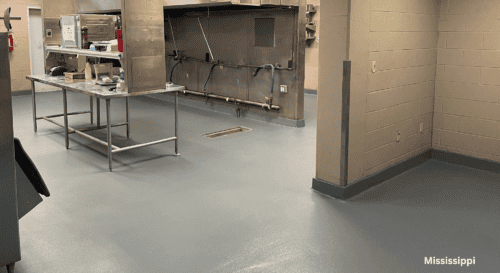
In Mississippi, those everyday demands can be combined with the heat and humidity common throughout the Gulf South. Commercial kitchen flooring needs to be able to hold up in an environment where moisture, temperature changes, and nonstop activity are simply part of the job.
Industrial Applications, Inc. installs commercial kitchen epoxy flooring throughout Mississippi, along with urethane cement flooring, MMA systems, antimicrobial coatings, coved bases, and other seamless resinous flooring systems built for demanding food-service operations.
We provide commercial kitchen flooring for restaurants, country clubs, schools, cafeterias, institutional kitchens, hospitality facilities, commercial food-preparation areas, and food-production operations across Mississippi.
No two kitchens run exactly the same way. Before recommending a flooring system, Industrial Applications looks at the existing concrete, how the kitchen is cleaned, exposure to heat and moisture, drainage, traffic patterns, safety requirements, and how much downtime is available for installation.
The goal is not simply to make the floor look better. It is to provide a commercial kitchen floor that can take a beating, clean up efficiently, provide appropriate traction, and help keep the kitchen moving day after day.
📞 Planning a kitchen renovation or dealing with a failing floor?
Call Industrial Applications Today
at 901-794-4334 or complete the contact form to speak with an experienced commercial flooring professional.
Contact Us For a Free In-Depth Flooring Evaluation
Concrete may look tough, but untreated concrete is naturally porous. Water, grease, cooking oils, food spills, detergents, sanitizers, and other liquids can work their way into the surface.
Over time, that exposure can leave concrete stained, pitted, cracked, worn, or increasingly difficult to clean.
In a commercial kitchen, those problems can develop even faster because the floor is rarely given much of a break. From the morning prep shift through the dinner rush and cleanup, back-of-house flooring may be exposed to moisture, heat, spills, rolling equipment, and constant traffic.
A properly installed commercial kitchen epoxy flooring system helps protect the concrete below while creating a durable, nonabsorbent surface that is easier to clean and maintain.
Water is part of everyday life in a commercial kitchen.
A seamless commercial kitchen flooring system reduces exposed joints and porous surfaces where moisture, grease, and debris can collect.
Commercial kitchen floors often sit next to fryers, ovens, kettles, grills, steam equipment, and other heat-producing appliances.
The right choice depends on the kitchen itself rather than taking a one-size-fits-all approach.
Anybody who has worked around a busy kitchen knows the floor sees more than water.
Industrial Applications can recommend a resinous flooring system with the appropriate chemical resistance for the kitchen’s normal operations and sanitation procedures.
During a lunch rush, dinner service, or high-volume food-production shift, keeping every inch of a kitchen floor perfectly dry is not always realistic.
Commercial kitchens stay busy.
Employees move constantly throughout the space while racks, carts, deliveries, supplies, and equipment travel across the floor throughout the day.
Then there are the inevitable dropped pans, cookware, containers, and equipment.
All of that creates concentrated wear and impact.
Commercial kitchen flooring is often called “epoxy flooring,” but epoxy is not the only resinous system available. In many kitchens, the best solution may include epoxy in some areas and urethane cement in others.
Industrial Applications selects the floor based on the conditions in each kitchen zone rather than applying one product throughout the building.
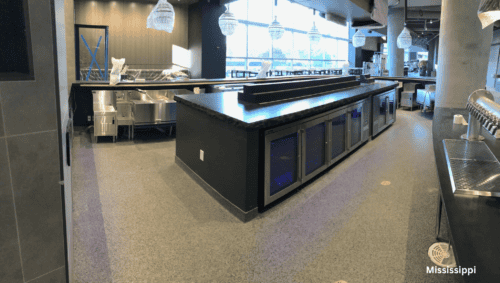 Industrial epoxy flooring can be a strong choice for areas that need a seamless, durable, cleanable surface but are not exposed to extreme thermal shock.
Depending on the system selected, epoxy may work well in:
Urethane cement, sometimes called cementitious urethane or urethane concrete, is frequently recommended for the most demanding kitchen zones.
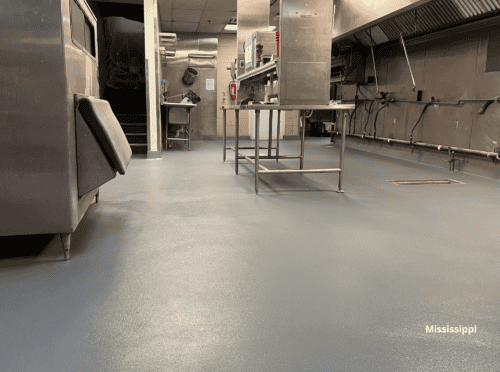
These may include:
Urethane cement is commonly selected for its resistance to thermal shock, moisture, chemicals, impact, and heavy traffic. Industrial Applications selected a cementitious urethane system for the Frida’s Restaurante Mexicano project because the kitchen required chemical resistance, thermal resistance, slip resistance, durability, and manageable maintenance.
The most expensive system is not automatically the best system for every square foot. A zone-based flooring plan can place higher-performance urethane cement in wet and hot areas while using epoxy or another appropriate resinous system in surrounding spaces.
This approach can help control project costs without under-specifying critical kitchen areas.
No flooring system by itself makes a commercial kitchen or food-processing facility compliant. Compliance depends on the complete operation, including food handling, sanitation procedures, drainage, equipment, employee practices, pest control, maintenance, and the physical condition of the building.
The floor should support those requirements rather than make sanitation more difficult.
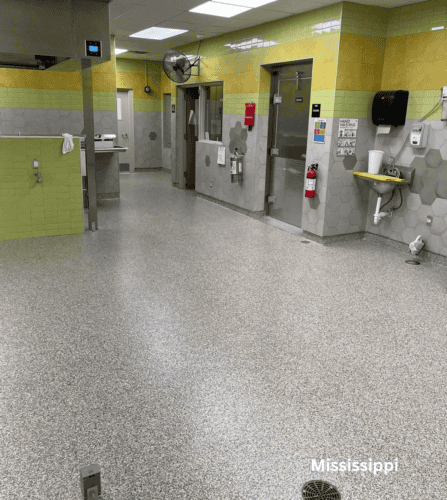
The FDA Food Code states that indoor floor surfaces in food establishments should be smooth, durable, and easily cleanable. Areas subject to moisture should also use nonabsorbent materials. The Food Code further addresses coved floor-to-wall transitions and requires floors used with water-flush cleaning methods to be graded to drain with coved and sealed junctures.
Tennessee food-service rules contain similar requirements for smooth, durable, easily cleanable surfaces; nonabsorbent materials in moisture-prone areas; and coved or sealed floor-to-wall transitions.
For USDA-regulated operations, federal sanitation standards state that floors must be constructed from durable materials that are impervious to moisture and capable of being cleaned and sanitized as necessary. Adequate drainage is also required in areas exposed to flooding-type cleaning or routine liquid discharge.
FSMA takes a prevention-focused approach to food safety. Covered food facilities may be required to maintain a written food-safety plan that includes hazard analysis and risk-based preventive controls. A cleanable, well-maintained flooring system can support that broader sanitation program, but the floor is only one part of facility-wide compliance.
Industrial Applications can help facility owners, architects, general contractors, and food-service operators select a flooring system that supports:
Final approval and compliance remain subject to the applicable regulatory authority, inspector, project specifications, and facility operation.
The field of the floor is only part of a sanitary flooring system. Floor-to-wall transitions, drains, equipment pads, columns, penetrations, joints, and door thresholds can become weak points when they are not properly detailed.
Tile floors contain grout lines. Sheet flooring contains seams. Standard wall bases may leave joints where water, grease, and debris can collect.
A poured resinous flooring system creates a more continuous surface with fewer places for residue to become trapped. Seamless construction also makes routine cleaning more predictable.
An integral coved base extends the flooring material vertically at the wall, creating a rounded transition instead of a sharp ninety-degree corner.
Coved bases can:
The height, radius, termination, and material of the cove should be selected for the facility and coordinated with wall finishes, equipment, drains, and cleaning procedures.
When specified, antimicrobial additives may be incorporated into certain resinous floor-coating systems to help inhibit the growth of microorganisms on the protected coating surface. Industrial Applications offers antimicrobial floor-coating options for commercial kitchens and other sanitation-sensitive environments.
Antimicrobial flooring does not replace proper cleaning, sanitizing, drainage, or maintenance. It should be treated as an additional feature within a complete sanitation program.
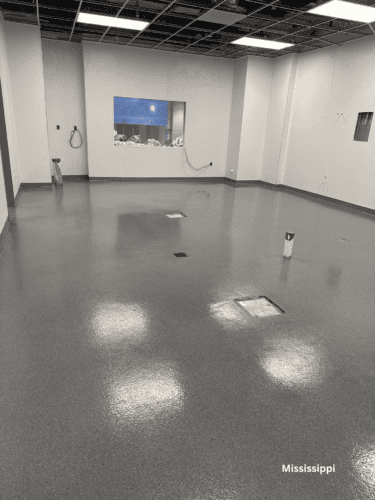
Closing a kitchen for an extended flooring installation can affect revenue, food production, staffing, events, deliveries, and customer service. Industrial Applications plans commercial kitchen flooring projects around the facility’s available downtime whenever project conditions allow.
Depending on the size of the kitchen, existing floor condition, selected system, and required repairs, work may be scheduled:
A commercial kitchen flooring project may include:
Where return-to-service time is especially limited, a fast-curing system such as MMA may be considered. Industrial Applications has installed Silikal MMA flooring in institutional kitchen projects where seamless construction, durability, maintenance, and heavy-traffic performance were important.
The exact reopening time depends on the flooring material, temperature, humidity, concrete condition, repair requirements, and kitchen use. Industrial Applications establishes the expected cure and return-to-service schedule before installation so operators can plan confidently.
📞 Have a narrow shutdown window?
Call Industrial Applications Today
at 901-794-4334 or submit the project form. An experienced professional can review the schedule and recommend a flooring system and installation sequence built around your operation.
Contact Us For a Free In-Depth Flooring Evaluation
Industrial Applications has served industrial and commercial customers since 1989, providing high-performance flooring systems for demanding facilities throughout Mississippi and across the Mid-South.
Industrial Applications has completed commercial kitchen flooring projects where sanitation, durability, slip resistance, chemical exposure, and thermal stress were critical considerations. These projects demonstrate how the right flooring system should be selected around the actual operating conditions of the kitchen—not simply by choosing a generic coating.
For restaurant and institutional kitchen projects, Industrial Applications has installed cementitious urethane flooring systems designed to withstand moisture, grease, cleaning chemicals, heavy foot traffic, and temperature changes.
One example is a restaurant kitchen where Industrial Applications recommended a Dur-A-Flex Poly-Crete MD cementitious urethane system because chemical resistance, thermal resistance, slip resistance, maintenance, and long-term durability were important to the facility.
The Industrial Applications project portfolio includes restaurant kitchens, school kitchens, cafeteria areas, fast-food kitchens, decorative flake flooring, and food-production environments.
Depending on the facility and operating conditions, Industrial Applications installs systems such as:
The flooring system is selected based on the needs of the facility, including cleaning procedures, traffic, temperature exposure, chemicals, moisture, and available downtime.
Industrial Applications evaluates and installs commercial kitchen flooring systems throughout Mississippi and the surrounding Mid-South, including:
Whether the project involves a restaurant kitchen, institutional food-service operation, cafeteria, commercial cooking facility, or food-production environment, Industrial Applications can help determine which flooring system is best suited for the conditions.
Commercial kitchen flooring requires more than applying a coating. The contractor must understand concrete preparation, moisture, drainage, thermal exposure, chemical resistance, coved transitions, slip resistance, cure time, and the realities of working inside an operating food-service facility.
Industrial Applications provides:
Industrial Applications does not begin with a product name. The process begins with the kitchen, the concrete, and the way the facility operates.
A commercial kitchen floor should make the facility easier to operate—not create another maintenance problem.
Industrial Applications can evaluate your existing floor and help determine:
📞 Have a narrow shutdown window?
Call Industrial Applications Today
at 901-794-4334 or fill out the project form to request a free in-depth floor evaluation. Speak with an experienced commercial flooring professional and get a system recommendation based on your kitchen—not a generic coating proposal.
Contact Us For a Free In-Depth Flooring Evaluation

